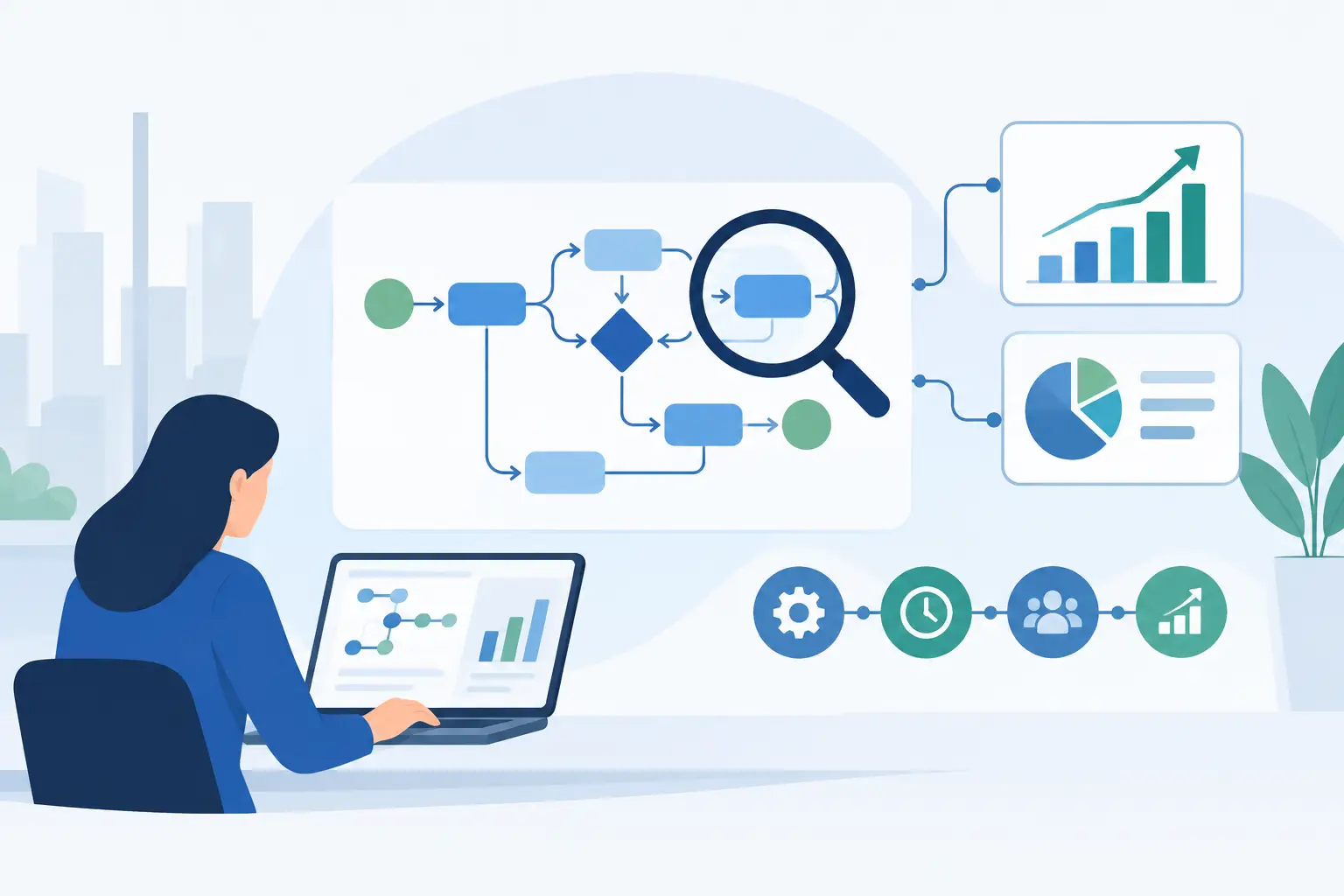
A quarterly operations review can show that order fulfillment is missing targets, customer onboarding is taking too long, or approvals are backing up. What it often cannot show is where the work actually slows down. Process mining closes that gap by using the digital records already created in business systems to reconstruct how a process runs in practice, not how it was designed to run.
For enterprise leaders, that distinction matters. Transformation programs frequently begin with assumptions about process maturity, team adoption, and system behavior. Process mining replaces assumptions with evidence. It reveals the routes work takes across CRM, ERP, service, finance, and workflow platforms, including the exceptions, handoffs, rework loops, and approval delays that consume time and create risk.
What Process Mining Actually Measures
Most enterprise processes leave a digital trail. A customer case is opened, assigned, escalated, resolved, and closed. A purchase request is submitted, reviewed, approved, and converted into an order. Each activity is typically recorded with a case identifier, an event name, and a timestamp. Process mining analyzes those event logs to produce a factual view of process execution.
This is different from a process map created in a workshop. Process maps are still valuable because they capture intended design, ownership, and policy. Yet they are often based on interviews and a limited sample of experiences. Process mining evaluates thousands or millions of real transactions. It can show that a supposedly linear process has 18 common variations, that one region bypasses a standard review step, or that a small percentage of cases generates most of the rework.
The result is not merely a visualization. It is an operational diagnostic. Leaders can measure cycle times, waiting times between activities, exception rates, repeat work, compliance with defined process paths, and differences between teams, product lines, or geographies.
Why Process Mining Has Become a Transformation Priority
Enterprises have invested heavily in platforms intended to standardize work. CRM, ERP, customer service, project management, and automation tools can improve execution, but implementation alone does not guarantee consistent adoption. Teams adapt systems around local needs. They create workarounds, move decisions into email, add manual checkpoints, or maintain parallel spreadsheets when the configured workflow does not match reality.
Those gaps are costly because they are difficult to see at an executive level. A dashboard may report average resolution time while masking the fact that a subset of requests sits idle for days before assignment. A CRM audit may find incomplete data, but not immediately explain whether missing fields originate in poor training, overly complex forms, unclear account ownership, or a downstream integration issue.
Process mining gives transformation leaders a way to connect system data with operating behavior. It helps answer questions such as:
- Which process variants create the longest cycle times?
- Where do approvals wait, and is the delay caused by capacity, policy, or unclear ownership?
- Which teams consistently follow the target process, and what enables that performance?
- How much rework is generated by incomplete or inaccurate data at the first point of entry?
- Are automation investments removing meaningful effort or simply accelerating a flawed workflow?
These answers help organizations prioritize operational efficiency solutions based on business impact rather than anecdote. That is particularly useful when multiple transformation initiatives are competing for funding and leadership attention.
The Value Is in the Questions, Not Just the Data
A process mining initiative can fail when it is treated as a technical reporting exercise. Clean event data and sophisticated analytics do not create improvement on their own. The value comes from asking focused business questions and connecting findings to decisions.
Consider a sales-to-service handoff. Leadership may initially ask why implementation projects begin late. Process analysis might reveal that the delay is not in project staffing. Instead, it may show that customer requirements are captured inconsistently in the CRM, creating clarification loops between sales, customer success, and delivery. The most effective response may be a revised qualification process, structured CRM fields, clearer accountability, and targeted enablement, rather than adding project managers.
This is where process mining supports strategic consulting methodologies. It provides evidence for diagnosing root causes, but the organization still needs a practical operating model for acting on the evidence. That includes decision rights, performance measures, workflow design, platform configuration, training, and change management.
The right scope also depends on the question. A broad enterprise-wide analysis can identify major opportunities, but it may produce a large volume of findings with no clear owner. A focused initiative around invoice exceptions, service case escalation, customer onboarding, or campaign approvals can deliver a faster path from insight to implementation. Neither approach is automatically better. The choice should reflect business urgency, data readiness, and the organization’s capacity to make changes.
Building a Process Mining Program That Drives Action
Effective programs begin with a process that has clear business relevance. High-volume workflows with measurable delays, compliance exposure, revenue impact, or customer friction are strong candidates. It is also useful to select an area where operational leaders are prepared to challenge existing practices rather than defend them.
Establish a business baseline
Define the performance problem before extracting data. For example, the objective might be to reduce onboarding time, improve first-contact resolution, increase quote-to-cash speed, or reduce manual journal-entry exceptions. Establish the measures that matter, including cycle time, cost per transaction, service-level performance, rework rate, conversion, or control adherence.
A baseline creates discipline. Without it, teams can spend months examining interesting patterns that have limited strategic value.
Prepare event data with operational context
Event logs often sit across multiple systems, and the data may not be immediately usable. Case identifiers can be inconsistent, timestamps may be incomplete, and activity labels may reflect system terminology rather than business meaning. Data preparation is not a minor technical task. It is a translation exercise between system records and the operating process leaders need to manage.
This stage should involve process owners, data specialists, and platform administrators. Together, they can validate which events represent meaningful work, how separate records should be connected, and where known data-quality issues may affect interpretation. A flawed data model can produce highly precise but misleading findings.
Separate variation from dysfunction
Not every process variation is a problem. Enterprise work often requires legitimate differences based on customer segment, contract value, regulatory requirements, product complexity, or risk level. The goal is not to force every case through one path. The goal is to distinguish purposeful variation from avoidable friction.
For instance, a high-value account may require additional legal and security reviews. That is a deliberate control. By contrast, repeated reassignment of a standard support case may indicate unclear routing rules, poor categorization, or gaps in knowledge management. Process mining provides the visibility; leaders must apply business judgment.
Turn findings into workflow changes
The most productive analyses lead directly to action. That action may include simplifying an approval chain, redesigning intake forms, clarifying ownership, changing CRM validation rules, automating notifications, or configuring project work so dependencies and handoffs are visible.
Implementation should be sequenced. Addressing one bottleneck can expose another, and major redesigns can create adoption fatigue. Start with changes that improve a defined outcome, assign accountable owners, and measure performance after implementation. This creates a repeatable improvement cycle rather than a one-time analytics project.
Where Process Mining Fits With CRM and Work Management
Process mining is especially useful when customer systems and work management platforms need to operate as one performance system. A CRM may capture the commercial and customer record, while a platform such as Asana coordinates delivery activities, internal approvals, and cross-functional execution. If the handoff between them is poorly defined, teams may duplicate data, lose context, or rely on manual follow-up.
Analyzing the end-to-end process can show where records stall, where information is re-entered, and whether teams are operating from consistent definitions. The answer may involve a CRM audit, revised data governance, integration design, or a better work intake structure. Technology choices should follow the process evidence, not the other way around.
This also changes how leaders evaluate adoption. Login rates and task completion counts are useful signals, but they do not prove that the operating model is working. A platform is performing when it reduces ambiguity, supports accountable handoffs, and helps teams move priority work forward with fewer exceptions.
Governance Determines Whether Gains Last
Process insights lose value when no one owns the response. Each priority finding should have an executive sponsor, a process owner, a delivery lead, and an agreed performance measure. The governance model does not need to be burdensome, but it must make decisions visible and establish who can change policy, workflow, data standards, or system configuration.
Leaders should also avoid using process data as a narrow productivity surveillance tool. When teams believe analytics will be used primarily to assign blame, they may resist the initiative or work around the measured process. The stronger approach is to use the evidence to remove obstacles, clarify responsibilities, and improve the conditions for reliable execution.
Process mining is most valuable when it becomes part of operational management, not a periodic diagnostic reserved for a transformation program. The organizations that benefit most are those willing to treat what the data reveals as a prompt for better design, clearer accountability, and disciplined follow-through.