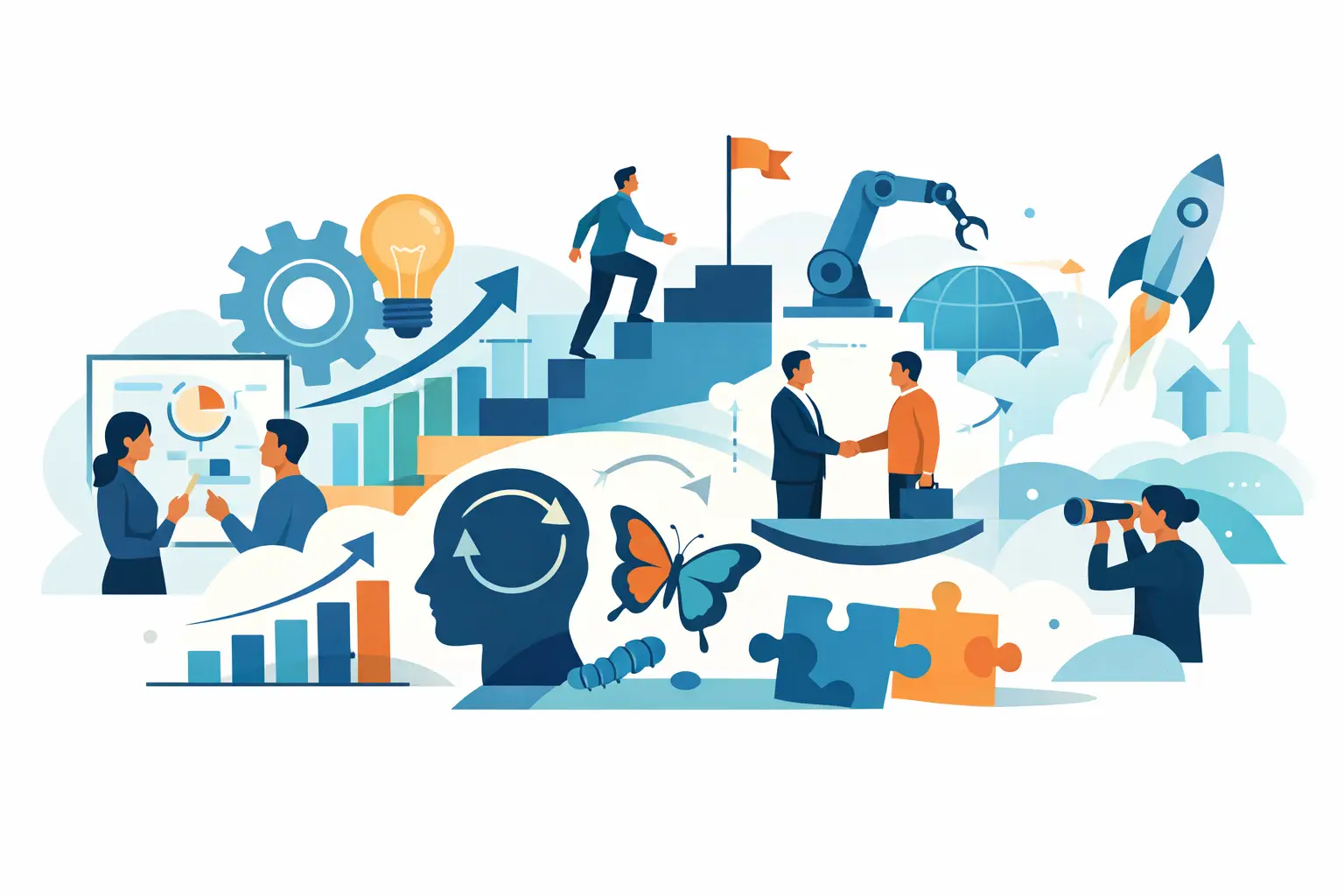
A reorg can change reporting lines overnight and still leave the business slower than it was before. That is why organizational transformation examples matter. They show the difference between surface-level change and the kind of structural, operational, and digital shifts that improve execution across the enterprise.
For most leadership teams, transformation is not a branding exercise. It is a response to friction that has become too expensive to ignore - slow handoffs, disconnected systems, unclear ownership, poor visibility, and inconsistent customer or employee experiences. The strongest examples are not defined by dramatic announcements. They are defined by measurable gains in alignment, throughput, accountability, and decision quality.
What strong organizational transformation examples have in common
Across industries, the most effective transformations share a practical pattern. They start with a business constraint, not a tool. Leadership identifies where performance is breaking down, whether that is in customer acquisition, service delivery, forecasting, compliance, or internal coordination. From there, the organization redesigns how work moves.
This usually affects more than one layer of the business at once. Structure changes, but so do workflows, governance, systems, performance metrics, and management cadence. That is why transformation often feels difficult. It is not one initiative. It is a series of connected decisions that must hold together under real operating pressure.
There is also a trade-off that many companies underestimate. Standardization improves speed and visibility, but too much of it can reduce flexibility for teams that need local control. Centralization can improve governance, but it can also create bottlenecks if decision rights are not clearly defined. Good transformation design balances consistency with execution reality.
7 organizational transformation examples in practice
1. Centralizing fragmented operations into a shared services model
A common enterprise problem starts with each business unit building its own way of working. Finance requests move one way in one division and another way elsewhere. HR, procurement, and reporting all follow slightly different rules. Over time, cost rises and visibility drops.
One of the clearest organizational transformation examples is the move to a shared services model. Instead of allowing support functions to operate independently across departments, the organization centralizes core processes, standardizes intake, and defines service levels. This reduces duplication and makes performance measurable.
The benefit is not only lower overhead. Leaders gain comparable data, more predictable cycle times, and clearer accountability. The risk is that centralization can feel distant to business units if the new model is designed for control rather than responsiveness. The organizations that succeed usually build service governance into the operating model from the start.
2. Moving from functional silos to cross-functional delivery teams
Many enterprises are organized for specialization, not flow. Marketing, sales, operations, customer success, and IT all have strong capabilities, but work stalls between teams. Ownership becomes blurred in the spaces between functions.
A transformation here often involves shifting from siloed departments to cross-functional teams aligned around products, customer journeys, or strategic outcomes. Instead of routing work through layers of approval and disconnected handoffs, the business creates teams that can plan, execute, and improve together.
This model tends to improve speed and reduce coordination loss. It also exposes a leadership challenge. Cross-functional teams work best when decision rights are explicit and priorities are managed centrally enough to prevent resource conflict. Without that structure, collaboration turns into negotiation and progress slows again.
3. Rebuilding customer operations around a CRM-led process
In many organizations, the CRM is technically in place but operationally weak. Sales updates one set of fields, account management tracks activity elsewhere, and leadership still depends on spreadsheets to understand pipeline or retention risk. The technology exists, but the business process does not.
A meaningful transformation example is when a company redesigns customer-facing operations around a governed CRM workflow. This includes clarifying stage definitions, standardizing data capture, improving handoffs from marketing to sales and from sales to service, and creating dashboards leaders can trust.
The result is not simply cleaner records. Forecasting improves, revenue teams operate from the same source of truth, and customer transitions become less error-prone. This kind of transformation works when the CRM is treated as an operating system for commercial execution, not just a database. That often requires process redesign before configuration changes.
4. Replacing informal project management with enterprise work management
As companies grow, work coordination often becomes scattered across meetings, inboxes, spreadsheets, and individual habits. Teams spend too much time asking for status updates and not enough time moving priorities forward. Strategic initiatives then compete with daily operations in a system with no common visibility.
An increasingly relevant transformation is the move to enterprise work management. Here, the organization implements a consistent framework for intake, prioritization, ownership, timelines, dependencies, and reporting across teams. Platforms such as Asana can support this shift, but only when paired with governance and adoption planning.
The operational gains are significant. Leaders can see where work is blocked, managers can allocate capacity with more confidence, and teams know how priorities connect to larger goals. The caution is straightforward: a work management platform does not fix unclear decision-making. If roles, approval paths, and portfolio priorities remain vague, the software will mirror the confusion.
5. Shifting from legacy hierarchy to a more agile governance model
Some organizations are not slow because employees lack urgency. They are slow because every meaningful decision requires too many approvals. Legacy governance structures often reflect a lower-growth, lower-complexity period in the business. As conditions change, the model becomes a drag on execution.
Transformation in this case means redesigning governance so decisions happen at the right level, with the right information, at the right speed. That may include defining thresholds for escalation, creating steering groups for major initiatives, reducing review layers, and clarifying who owns outcomes versus who provides input.
This type of change is especially valuable in digital transformation programs, where technology, process, and change management must move in sync. Still, it depends on leadership discipline. Faster governance is not lighter governance. It requires stronger clarity, better data, and more consistent operating rhythms.
6. Standardizing processes after acquisition or rapid expansion
Growth creates complexity quickly. After acquisitions or aggressive expansion, enterprises often inherit multiple tools, duplicated roles, inconsistent policies, and competing process logic. Integration risk rises, and employees spend more time translating between systems than serving customers or delivering projects.
One of the most practical organizational transformation examples is post-growth process harmonization. The company maps critical workflows across entities, identifies what should be standardized, and decides where local variation still makes sense. Supporting systems are then consolidated or integrated to reduce fragmentation.
This is not a purely operational exercise. It directly affects culture, accountability, and speed to value from the acquisition. Push too hard for uniformity and the business may lose useful local practices. Move too slowly and complexity becomes permanent. Strong programs distinguish between strategic standardization and unnecessary forced sameness.
7. Building a digital operating model around measurable execution
Some transformation efforts fail because they are framed too narrowly as software implementation. The business launches a new platform, trains users, and expects performance to improve. When results are uneven, leaders conclude the tool was underused. In reality, the operating model was never redesigned.
A stronger example is building a digital operating model that connects strategy, processes, systems, and performance management. This means defining how work is requested, approved, executed, measured, and improved across the organization. It often includes workflow platforms, system integrations, role clarity, KPI alignment, and regular review cadences.
For enterprises pursuing scale, this is where digital transformation starts producing operational efficiency rather than isolated upgrades. It is also where consulting and implementation need to work together. A strategy without adoption mechanisms stays theoretical. A tool rollout without operating discipline stays tactical. Firms like Efience focus on that intersection because it is where transformation becomes usable.
How to evaluate which transformation example fits your business
The right model depends on where performance is breaking down. If the issue is duplicated support activity, shared services may be the answer. If priorities stall between departments, cross-functional design or work management may matter more. If customer visibility is weak, CRM-led transformation deserves attention before broader organizational redesign.
Leadership teams often make the mistake of choosing a transformation pattern based on what peers are doing. A better starting point is to identify the cost of the current state. Where are delays happening? Which decisions lack ownership? Which systems create rework? What cannot be measured reliably today? Those questions usually reveal whether the problem is structural, procedural, technological, or a combination of all three.
It also helps to assess readiness honestly. Some organizations are capable of absorbing major operating model change quickly. Others need phased transformation with narrower pilots and tighter change support. Speed matters, but absorption capacity matters too. The best transformation is not the boldest design on paper. It is the one the organization can execute and sustain.
Transformation becomes real when employees experience less friction doing important work. That is the standard worth using. If the future-state model improves clarity, strengthens accountability, and helps teams move with fewer handoff failures, it is on the right track.