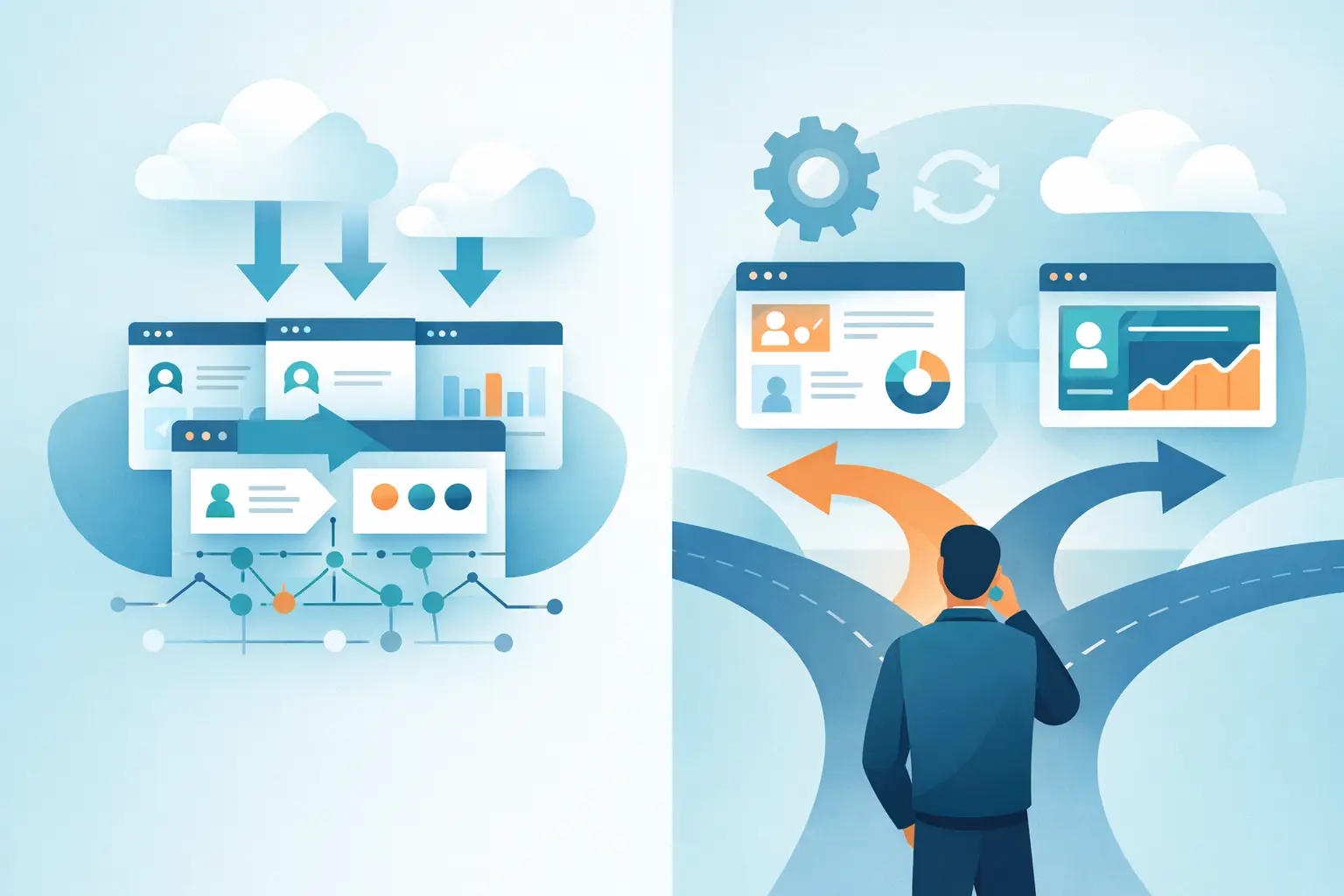
A CRM decision rarely starts with a blank slate. It starts with frustrated sales teams, duplicate records, disconnected service histories, inconsistent pipeline reporting, and a growing concern that the platform is no longer supporting the operating model. CRM consolidation versus replacement is the decision point behind many transformation programs, but treating it as a software choice alone creates unnecessary cost and risk.
The better question is whether the organization’s performance issues come from too many systems, poor system design, weak governance, or genuine platform limitations. The answer determines whether leaders should consolidate the CRM environment, replace it, or sequence both actions as part of a broader transformation roadmap.
What CRM consolidation versus replacement really means
CRM consolidation brings customer data, workflows, and teams into fewer systems, ideally one governed source of truth. It may involve retiring regional instances, eliminating point solutions, standardizing fields, integrating adjacent platforms, or moving business units onto a shared CRM tenant. The core platform may remain in place.
Replacement means selecting and implementing a different CRM platform because the current one cannot reasonably support business requirements. The need may be driven by major gaps in scalability, integration capability, data architecture, industry requirements, security controls, user experience, or total cost of ownership.
These paths are not mutually exclusive. An enterprise may first consolidate fragmented CRM instances to improve data quality and reduce operating complexity, then determine whether the resulting environment can meet future-state needs. Another organization may replace a legacy platform and use the implementation to consolidate several systems at once.
The distinction matters because each path carries a different level of organizational change. Consolidation concentrates on rationalization and standardization. Replacement introduces a new platform, new configuration decisions, new integrations, and a more demanding adoption effort. Neither is automatically the more strategic option.
Start with the operating model, not the platform
A CRM reflects how an organization acquires, serves, and retains customers. When teams have different definitions of a qualified lead, account owner, renewal opportunity, or customer status, changing the software will not resolve the underlying conflict. It may simply reproduce it in a new environment.
Before approving a program, leaders should establish the intended customer operating model. Clarify which teams use the CRM, what decisions they need to make, who owns each stage of the customer lifecycle, and which workflows must cross functional boundaries. Sales, marketing, customer success, service, finance, and operations often have valid but competing requirements. A shared design authority is needed to resolve them.
This is also where process simplification should occur. Many CRM environments become difficult because they automate exceptions that should be eliminated, not preserved. A replacement project can make this problem more expensive by migrating every legacy field, approval, and customization without challenge.
A practical assessment separates requirements into three categories: capabilities that are genuinely required, processes that need redesign, and preferences that have accumulated over time. Only the first category should drive a platform decision.
When consolidation is the stronger business case
Consolidation is often the right direction when the enterprise already has a capable CRM platform but has allowed fragmentation to grow around it. Common symptoms include separate instances following mergers, business units managing their own customer records, overlapping sales tools, and inconsistent reporting across regions.
The financial case can be substantial. Fewer applications reduce license overlap, integration maintenance, administration demands, and security exposure. More significantly, unified customer data improves management visibility. Leaders can evaluate pipeline health, account penetration, service trends, and forecast performance using consistent definitions rather than reconciling reports from multiple teams.
Consolidation also supports stronger governance. A common data model, role structure, lifecycle process, and change-management framework make it easier to control quality as the organization grows. That does not require every business unit to operate identically. It requires deliberate decisions about where standardization creates value and where local variation is necessary.
However, consolidation has limits. Combining several poorly configured environments into one larger environment does not create operational efficiency. It can centralize technical debt, frustrate users, and make future change slower. The consolidation plan must include data remediation, process redesign, and a clear retirement schedule for redundant tools.
When replacement is justified
Replacement becomes appropriate when the current CRM creates structural constraints that configuration, integration, or governance cannot solve at a reasonable cost. This is different from user dissatisfaction. Dissatisfaction may be caused by poor training, inconsistent data, or a workflow that was designed without input from frontline teams.
A replacement case is stronger when the organization faces several material issues at once. The platform may not support required integrations, may demand excessive custom development for routine workflows, may be difficult to secure or govern, or may prevent the organization from adopting essential analytics and automation capabilities. Persistent dependence on manual exports and spreadsheets is often a warning sign, especially when it affects forecasting, compliance, or customer service.
Mergers and acquisitions can also change the equation. A company may inherit multiple CRM platforms, each with contracts, integrations, and user communities. If no single incumbent system can support the combined organization’s future operating model, choosing a new standard can be less costly than forcing one legacy platform to fit every requirement.
Replacement should still be tested against a realistic total cost model. License price is only one component. Include implementation services, integration rebuilds, data migration, testing, training, internal product ownership, change management, post-launch support, and the productivity impact of transition. A lower subscription price can conceal a much larger transformation investment.
Evaluate the decision through five lenses
A disciplined assessment prevents teams from choosing based on executive preference or a compelling product demonstration. Review the current environment and potential future state across five lenses.
Business fit. Can the platform support the target customer operating model, revenue motions, service processes, and reporting requirements without excessive workarounds? Focus on the workflows that affect revenue, customer experience, and risk, not a generic feature checklist.
Data and integration architecture. Determine where customer master data should live, how identity resolution works, and which systems exchange information with the CRM. ERP, marketing automation, service platforms, product data, data warehouses, and collaboration tools all influence the answer. A CRM cannot become a trusted system of record if its data architecture remains ambiguous.
Operational complexity. Measure the number of instances, customizations, integrations, duplicate fields, manual handoffs, and local exceptions. Complexity is not merely an IT concern. It directly affects onboarding, reporting reliability, release speed, and user confidence.
Adoption and accountability. Examine actual usage by role, data-entry burden, manager behavior, and the effectiveness of training. If leaders do not use CRM reports to run the business, teams have little reason to maintain accurate records. Adoption improves when workflows give users immediate value and governance makes ownership visible.
Economics and risk. Compare the cost of improving the current environment with the full cost and risk of replacement. Consider contract timing, implementation capacity, regulatory obligations, security requirements, and the risk of disrupting revenue operations during a major rollout.
Build a phased decision, not a binary mandate
For large enterprises, a phased approach usually produces a more reliable outcome than a sudden enterprise-wide mandate. Start with an independent CRM audit that maps applications, integrations, data quality, customization, process variation, and ownership. The objective is not to document every defect. It is to identify the constraints that materially limit performance.
From there, define a future-state architecture and a prioritized business case. Some improvements may be immediate: standardizing pipeline stages, removing duplicate fields, establishing data stewardship, or retiring a redundant sales tool. Others may require a larger platform decision.
If replacement is selected, avoid a lift-and-shift migration. Design the future process first, migrate only data with a defined business purpose, and establish governance before launch. If consolidation is selected, make retirement measurable. Applications without a firm decommissioning plan tend to remain in use, recreating the fragmented environment the program was meant to resolve.
Program governance should include business owners, operations leaders, technology teams, data stakeholders, and representatives from affected user groups. CRM transformation fails when it is treated as an isolated IT project, but it also stalls when every stakeholder can add requirements without a decision framework. Clear ownership and disciplined scope control are essential.
Make the CRM a performance system
The most effective CRM environments support consistent execution rather than simply storing customer information. They connect strategic priorities to the daily work of teams: how leads are routed, how opportunities are advanced, how accounts are managed, how service issues are escalated, and how leadership measures performance.
That requires attention beyond the CRM itself. Project and workflow management practices can coordinate implementation work, clarify cross-functional accountability, and give leaders visibility into risks and dependencies. Efience approaches CRM assessment in this broader operational context, connecting system choices to the processes and behaviors required for sustained adoption.
The right decision is the one that reduces friction while increasing organizational control. If the current platform can support that goal after rationalization, consolidation may protect investment and accelerate improvement. If it cannot, replacement may be necessary. Either way, begin by defining the work the organization needs to perform better, then build the CRM environment to make that work easier to execute.