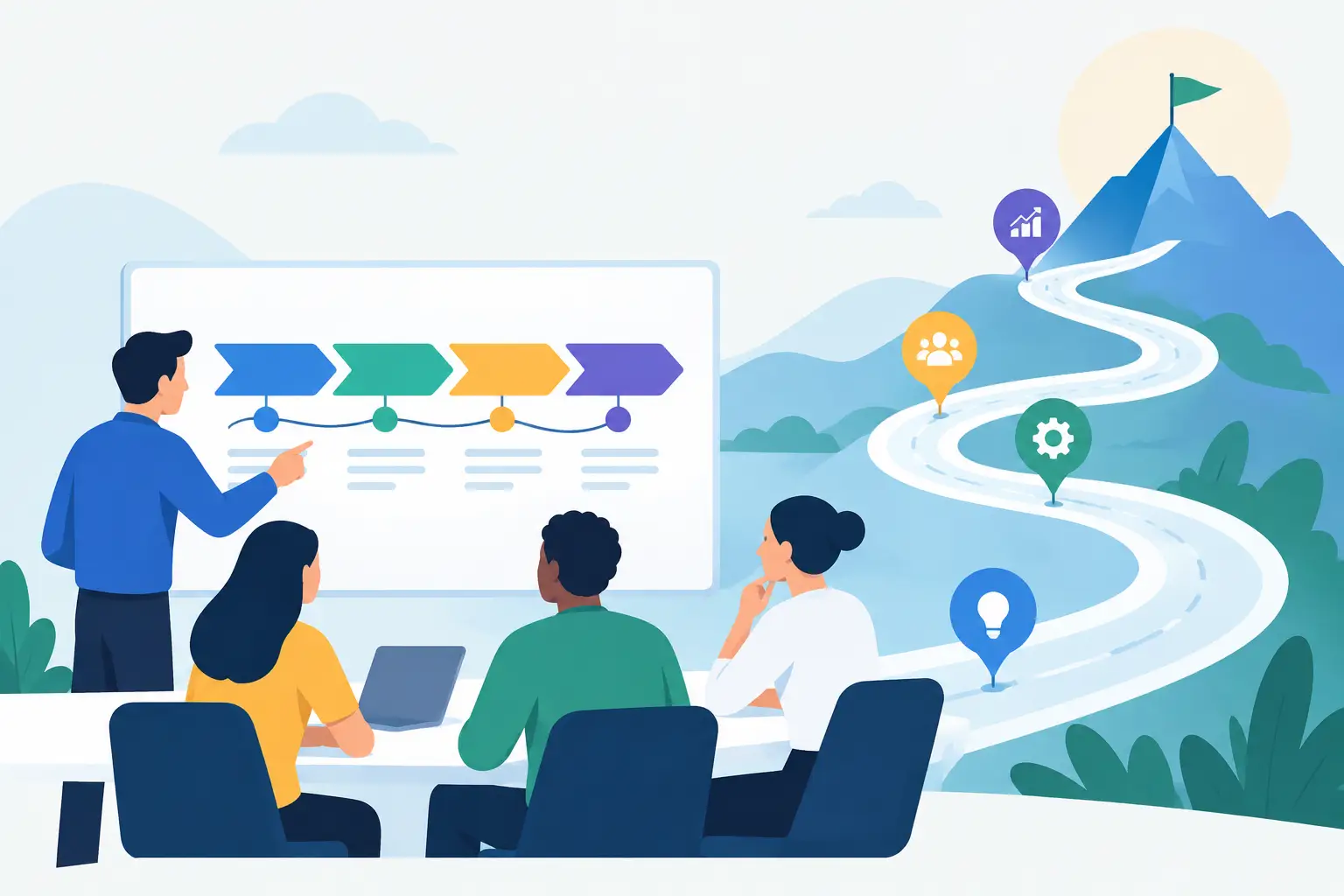
A transformation program rarely fails because leaders lack ambition. It fails when strategic intent is not translated into owned work, decision points, dependencies, and measurable outcomes. The best transformation roadmap templates create that translation layer. They give executives a common view of the change while giving delivery teams enough structure to act with confidence.
For enterprise leaders, the right template is not a polished timeline for a steering committee deck. It is an operating tool that connects business priorities to portfolios, platforms, process changes, adoption activities, and governance. The format should reflect the scale and uncertainty of the work, not force a complex program into a generic project plan.
What a Transformation Roadmap Template Must Do
A useful roadmap answers a small set of difficult questions clearly: What business outcome are we pursuing? What must change to achieve it? Who owns each workstream? What must happen first? How will leadership know whether the program is creating value?
That makes a transformation roadmap different from a task list, an annual operating plan, or a product release calendar. It operates at a higher level than individual tasks but must be specific enough to expose sequencing and accountability. If it cannot show where a CRM cleanup affects sales process adoption, customer data governance, reporting, and training, it is too abstract to manage transformation.
The strongest templates typically include five core elements: strategic outcomes, transformation workstreams, phased milestones, accountable owners, and success measures. Risks, assumptions, funding gates, and key decisions should also be visible when the program has significant cross-functional dependencies.
7 Best Transformation Roadmap Templates
1. Enterprise Transformation Portfolio Roadmap
This is the most effective starting point for a broad, multi-year program involving several functions or business units. It organizes major initiatives under strategic themes such as customer experience, operational efficiency, data modernization, or workforce enablement.
The template should show each initiative across quarterly or semiannual horizons, along with executive sponsorship, expected value, investment level, and delivery status. It is particularly useful for transformation offices and executive steering committees that need to make prioritization decisions across a crowded portfolio.
Its trade-off is depth. A portfolio roadmap provides an enterprise-level view but should not become the delivery plan for every initiative. Pair it with more detailed workstream roadmaps to avoid hiding operational constraints behind green status indicators.
2. Digital Capability Roadmap
A capability roadmap is well suited to organizations modernizing how they serve customers, manage data, or execute internal work. Instead of organizing the plan around software purchases, it maps the capabilities the business needs to build or improve.
For example, a customer operations capability may include standardized intake, case routing, account visibility, service analytics, and knowledge management. The roadmap then connects those capabilities to enabling people, process, data, and technology changes.
This format prevents a common transformation mistake: treating a platform implementation as the transformation itself. A new CRM or work management platform can enable better performance, but only when the operating model, workflows, governance, and adoption plan are designed around the desired capability.
3. Operating Model Transformation Roadmap
When an organization is redesigning decision rights, team structures, service delivery, or shared processes, an operating model roadmap provides better structure than a technology-led template. It lays out the future-state model and the transition required to reach it.
The workstreams often include organization design, process standardization, governance, talent and skills, systems enablement, and performance management. Milestones should identify when leaders approve new ways of working, when pilot teams begin operating differently, and when legacy processes can be retired.
This template is most valuable when the transformation has direct implications for roles and accountability. Change resistance often rises when employees see systems changing but cannot see how decisions, handoffs, or success expectations will change with them.
4. Process Improvement Roadmap
A process improvement roadmap is appropriate when the business case centers on cycle time, cost, quality, compliance, or customer friction. It follows a practical progression: assess the current state, identify bottlenecks, redesign the process, pilot the new model, scale it, and monitor performance.
Unlike a traditional continuous improvement tracker, this roadmap should include the systems and data requirements behind the process. A redesigned approval workflow, for instance, may depend on cleaner master data, role-based permissions, automated routing, and reporting definitions that teams trust.
Use this format for targeted transformations where measurable operational improvement is the priority. It is less effective as the only enterprise roadmap if several unrelated business capabilities are changing at once.
5. Technology and Platform Implementation Roadmap
A platform roadmap provides structure for introducing or rationalizing core workplace technologies such as CRM, ERP, service management, analytics, or work management systems. The best version goes beyond implementation phases like design, configure, test, and launch.
It should show process decisions, data migration, integrations, governance, training, adoption, and post-launch optimization as connected workstreams. This matters because a technically successful launch can still produce poor adoption, duplicate processes, and unreliable reporting if those areas are managed separately.
For organizations implementing Asana or improving an existing deployment, the roadmap should define team taxonomy, workflow standards, permissions, reporting conventions, intake practices, and adoption ownership before configurations are scaled. Efience approaches this work as an operational performance system, not simply a tool rollout.
6. Customer Experience Transformation Roadmap
Customer experience roadmaps align customer-facing improvements across channels, teams, and systems. They are particularly useful when sales, service, marketing, operations, and digital teams each own part of the customer journey but lack a shared view of friction points.
The template can be organized around priority journeys, such as onboarding, issue resolution, renewal, or order management. Each journey should identify experience goals, internal process changes, data requirements, technology enablers, and performance measures such as effort, resolution time, retention, or conversion.
Avoid presenting customer experience as a collection of interface improvements. The most consequential friction often sits behind the interface: disconnected customer records, unclear ownership, inconsistent policies, or manual handoffs between teams.
7. Change Adoption and Benefits Realization Roadmap
Many transformation plans treat change management as a communications workstream that begins shortly before launch. A dedicated adoption and benefits roadmap corrects that gap by making behavior change and value realization visible from the beginning.
It should track stakeholder impact assessments, leadership alignment, role-based training, communications, champion networks, adoption metrics, and benefit reviews. It should also specify when the organization will validate whether anticipated gains are actually occurring.
This template is especially valuable for programs where the new process or platform requires people to make different decisions every day. Adoption is not complete when training attendance reaches a target. It is complete when the new operating behavior is consistently producing the intended result.
How to Choose the Right Roadmap Format
Choose the roadmap based on the primary transformation question leadership needs to answer. If the question is, “Which investments should we fund and sequence?” begin with the enterprise portfolio roadmap. If it is, “What must the business be able to do differently?” use a capability roadmap. If the immediate challenge is platform deployment, a technology implementation roadmap may be the right delivery backbone.
Large programs commonly need more than one view. An executive portfolio roadmap may sit above a detailed operating model roadmap, while individual platform teams maintain their own implementation plans. The goal is not to create duplicate reporting. It is to provide different levels of decision support from a consistent source of truth.
Keep the executive roadmap focused on outcomes, dependencies, decisions, and exceptions. Detailed delivery plans can live in the team’s work management environment, where owners can manage tasks, dates, risks, and changing priorities without overwhelming senior stakeholders.
Build the Template Around Evidence, Not Assumptions
Before populating a roadmap, establish a credible baseline. Measure current cycle times, error rates, customer outcomes, adoption levels, technology utilization, and team capacity where relevant. A roadmap without a baseline can show activity, but it cannot prove improvement.
Then define outcome measures that leadership can review at regular intervals. A process transformation might target a reduction in approval time and rework. A CRM program might target complete account data, higher opportunity hygiene, and improved forecast confidence. Measures should be specific enough to guide delivery choices, while remaining connected to business value.
Finally, make dependencies explicit. If a reporting launch depends on data definitions approved by multiple functions, show that dependency and name the decision owner. Hidden dependencies are one of the fastest ways for an apparently well-planned transformation to stall.
A roadmap earns its value when it changes the quality of decisions, not when it fills a presentation slide. Select the format that makes ownership, trade-offs, and measurable progress visible, then keep it current enough to guide the next decision your organization must make.