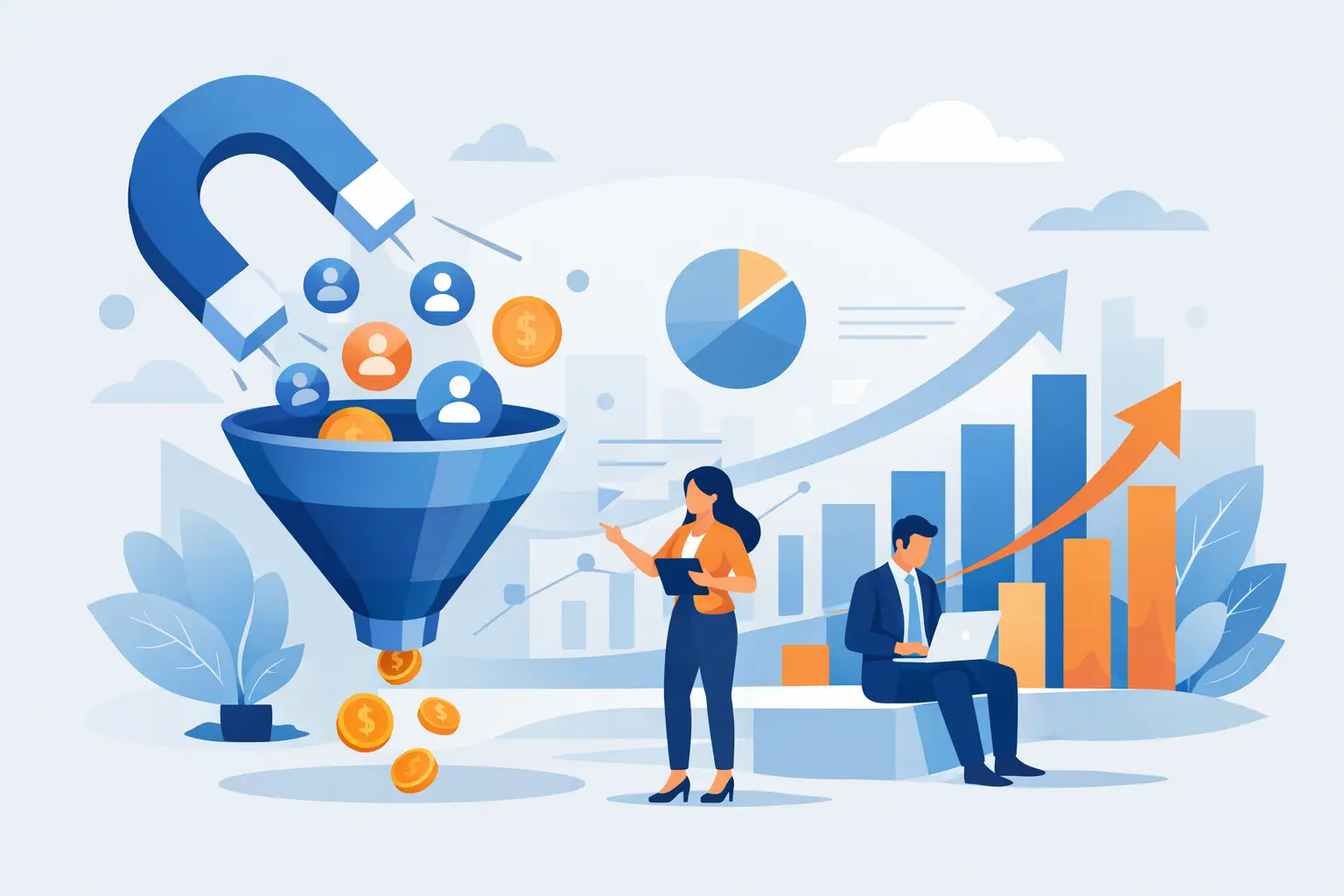
Pipeline problems rarely start at the top of the funnel. In most enterprise environments, lead generation breaks down because strategy, systems, and execution are misaligned. Marketing is producing activity, sales is asking for better-fit opportunities, and operations is left managing fragmented data, inconsistent follow-up, and unclear accountability. The issue is not always volume. More often, it is the absence of a structured operating model that turns interest into qualified demand.
For organizations investing in growth, lead generation should be treated as a business system, not a campaign category. That means looking beyond form fills and paid traffic to evaluate how targeting, messaging, CRM design, workflow automation, and sales handoff work together. When those elements are aligned, lead generation becomes more predictable, measurable, and easier to scale.
What lead generation actually means in an enterprise context
In smaller organizations, lead generation is often discussed as a set of marketing tactics. In enterprise settings, that framing is too narrow. Lead generation is the coordinated process of identifying the right audiences, creating meaningful engagement, capturing buying signals, and moving qualified opportunities into a sales process with minimal friction.
That definition matters because it changes how leaders evaluate performance. If marketing is measured only on inquiry volume, teams can optimize for the wrong outcome. A campaign may drive a high number of responses while creating little revenue value. On the other hand, a lower-volume program that reaches the right accounts, routes leads correctly, and supports timely follow-up can produce stronger pipeline efficiency.
This is where operational design becomes central. Enterprise lead generation depends on clear qualification criteria, shared definitions between teams, and systems that support execution instead of slowing it down.
Why lead generation often underperforms
The most common issue is not lack of effort. It is structural inconsistency.
Many organizations run multiple demand programs across business units, regions, or product lines without standardizing how leads are captured or evaluated. One team may define a marketing-qualified lead based on engagement score, while another uses firmographic fit or meeting requests. Sales teams then receive leads that do not reflect a shared standard, which weakens trust in the funnel.
Technology can add to the problem. A CRM filled with duplicate records, incomplete fields, and unclear ownership rules makes lead management harder than it needs to be. Automation may exist, but if it reflects outdated processes, it simply moves bad data faster. The result is a familiar pattern: slow response times, poor visibility, and inconsistent conversion rates.
There is also a strategic trade-off that organizations often overlook. Broad lead capture can increase raw volume, but it can also burden downstream teams with low-intent contacts. Tighter qualification improves efficiency, but if the threshold is too strict, valuable early-stage prospects may be ignored. The right model depends on sales cycle length, deal size, buying committee complexity, and available capacity for follow-up.
A better model for lead generation
High-performing organizations treat lead generation as part of revenue operations. Instead of separating campaign execution from process design, they build an integrated model that connects audience strategy, platform structure, and team accountability.
The starting point is targeting clarity. Enterprise teams need to know which segments matter most, what signals indicate buying readiness, and where outreach should be concentrated. This sounds straightforward, but many companies still rely on broad personas that are too general to guide precise execution. Stronger lead generation comes from sharper segmentation - by industry, buying role, business challenge, system maturity, or account priority.
Next comes the conversion framework. Organizations need a defined path from first engagement to sales readiness. That includes capture points, qualification logic, routing rules, response expectations, and status definitions within the CRM. Without this structure, even strong demand creation loses momentum once a prospect enters the system.
Then there is enablement. Sales and business development teams need context, not just contact data. If a lead is passed over with limited insight into source, behavior, and likely pain points, follow-up becomes generic and less effective. Lead generation improves when handoffs include the information needed for relevant, timely outreach.
Systems matter more than most teams admit
Lead generation performance is often discussed in creative or media terms, but operational infrastructure has just as much impact. A campaign can be well designed and still underperform if the supporting systems are fragmented.
CRM architecture is a major factor. If lead source values are inconsistent, lifecycle stages are unclear, or reporting fields are optional when they should be required, measurement becomes unreliable. Leaders then make decisions based on incomplete information, which affects budget allocation and team planning.
Workflow tools also shape execution. When follow-up tasks are managed manually or spread across disconnected platforms, accountability weakens. Teams lose visibility into what happened after a lead entered the funnel. This is where process design and platform integration become especially valuable. Better alignment between CRM, marketing automation, and work management tools reduces lag time and creates clearer ownership across the pipeline.
For enterprise teams, this is not a minor efficiency gain. It directly affects revenue velocity. Faster routing, cleaner records, and better internal coordination increase the chances that qualified opportunities are engaged before interest fades.
How to assess your lead generation model
A useful evaluation starts with a simple question: where does momentum slow down?
If lead volume is strong but conversion is weak, the issue may be targeting or qualification. If qualified leads exist but sales acceptance is low, the problem may be handoff quality or definition misalignment. If opportunities are created but pipeline progression stalls, the root cause may sit beyond lead generation itself, in sales process design or stakeholder engagement.
A serious assessment should examine both strategy and operations. Review how audiences are segmented, how campaigns map to buying stages, how qualification is defined, and how records move through the CRM. Then look at execution discipline. Are leads routed consistently? Are service-level expectations documented? Is follow-up monitored? Are teams working from the same performance definitions?
This is where organizations often discover that their challenge is not demand creation alone. It is system fragmentation. The companies that improve fastest are usually the ones willing to audit workflows, platform logic, and team responsibilities alongside campaign performance.
What effective lead generation looks like over time
Lead generation should produce more than monthly activity reports. It should create a repeatable pipeline engine that becomes easier to manage as the organization grows.
In practical terms, that means fewer disputes over lead quality, more reliable forecasting inputs, and stronger visibility into which channels and messages produce meaningful commercial outcomes. It also means teams spend less time reconciling data and more time acting on it.
There is no single blueprint that works for every enterprise. A company with a long consultative sales cycle will need a different qualification and nurture model than one selling a lower-complexity solution with shorter buying windows. Global organizations may require regional routing logic and governance standards that smaller firms do not. The right approach depends on operating complexity.
Still, the underlying principle is consistent. Lead generation performs best when it is designed as a managed system with clear rules, strong data integrity, and aligned execution. That is why organizations focused on operational efficiency often see better demand outcomes even before they increase spend. They remove friction from the process.
For companies pursuing transformation, this is a useful shift in perspective. Growth does not come only from generating more interest. It also comes from building the internal structure to convert interest with greater precision. That is where lead generation becomes an enterprise capability rather than a marketing function.
Efience Digital Experience works at this intersection of strategy, systems, and execution because sustainable growth depends on all three. When organizations treat lead generation as part of a broader operational model, they build a pipeline that is not only larger, but smarter.
The strongest next step is usually not another campaign. It is asking whether your current structure helps qualified demand move forward or quietly slows it down.