A missed handoff between sales and delivery can cost an enterprise far more than a delayed task. It can create duplicate customer records, force leadership to make decisions with incomplete data, and leave teams managing exceptions instead of serving the business. The future of enterprise workflows will be defined by how effectively organizations prevent that friction before it becomes routine.
For enterprise leaders, workflow modernization is no longer a question of adding another collaboration platform. Most organizations already have capable systems. The challenge is designing an operating environment where strategy, accountability, data, and daily work remain connected as priorities shift.
The Future of Enterprise Workflows Is an Operating Model
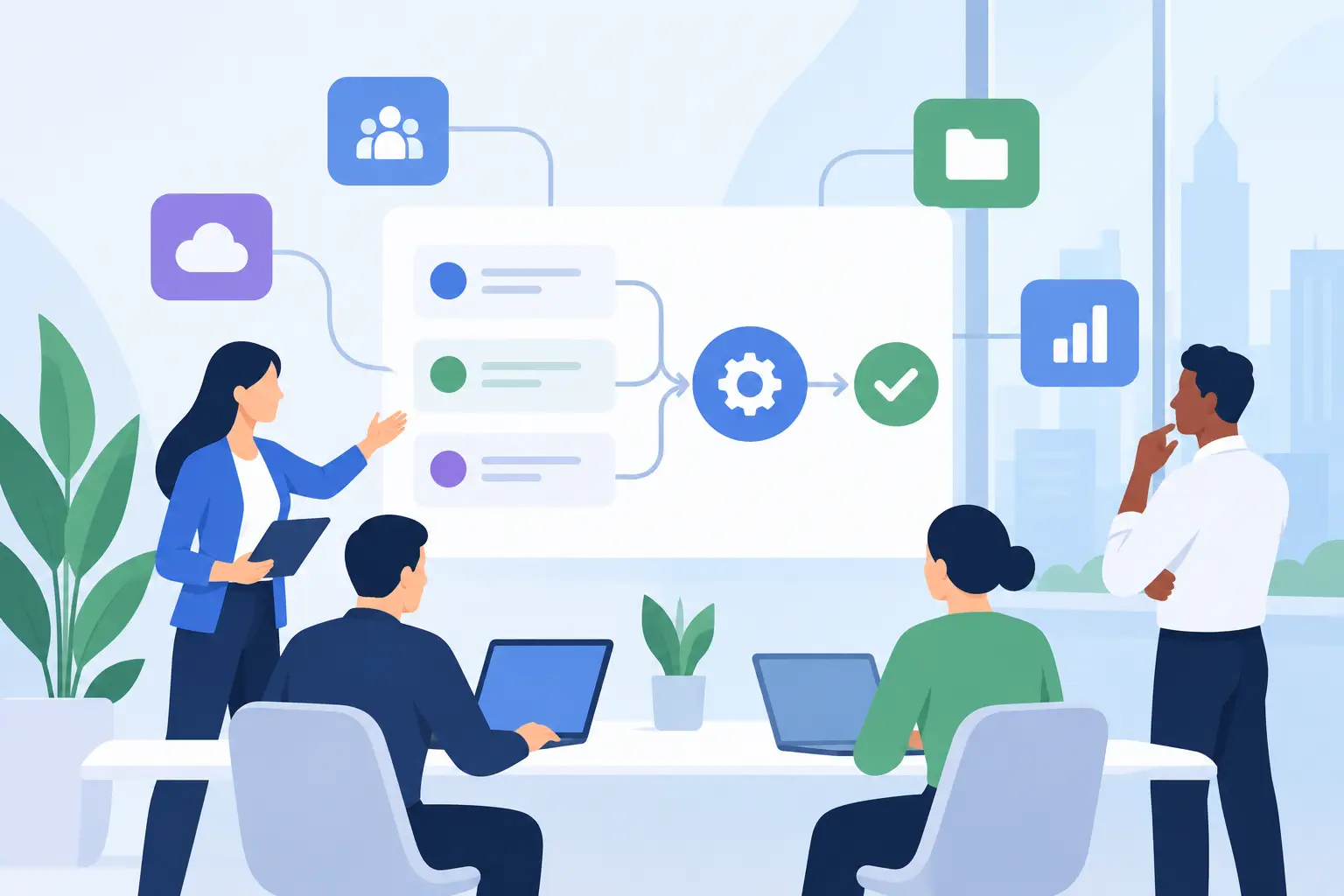
A workflow is often treated as a sequence of tasks inside a tool. That definition is too narrow for enterprise transformation. A meaningful workflow connects an operational trigger to an accountable owner, a defined decision, a system of record, and an outcome that can be measured.
Consider a new enterprise customer. The workflow does not begin when a project manager creates an onboarding task. It begins when the commercial team captures the right commitments, fields, and implementation assumptions. It continues through handoff, resource planning, customer communication, delivery milestones, change management, and account expansion. If those stages are disconnected, the organization may appear busy while operating without control.
The enterprises that perform well will design workflows as part of their operating model. They will clarify how work enters the organization, where decisions occur, which platform owns the data, and how exceptions are escalated. Technology supports that structure, but it cannot replace it.
This distinction matters because poorly designed processes can be digitized quickly. A workflow platform may make a broken approval path more visible, but visibility alone does not reduce rework or improve accountability. Modernization starts with the operating decisions that software must support.
From Tool Adoption to Workflow Architecture
Many transformation initiatives stall because they begin with a platform choice rather than a workflow architecture. Teams configure forms, projects, automations, and dashboards before agreeing on the standards those features are meant to enforce. The result is often inconsistent adoption: one business unit uses the system as intended, another relies on email, and a third maintains a parallel spreadsheet.
Workflow architecture establishes the rules that make technology useful across functions. It defines the common objects that matter to the business, such as accounts, initiatives, requests, risks, and approvals. It also defines the relationships between them. A sales opportunity should not become an implementation project through manual re-entry if the required information can be structured and transferred reliably.
A strong architecture does not require every team to work in exactly the same way. Finance, product, legal, and customer success have different responsibilities and risk profiles. The goal is not uniformity for its own sake. It is a shared foundation with enough flexibility for teams to execute effectively while preserving enterprise-level visibility.
Standardize the critical path, not every activity
The most effective organizations standardize high-impact workflows first. These are the processes that cross teams, affect customers, create compliance exposure, or consume significant management attention. Examples include lead-to-revenue, incident response, employee onboarding, contract approval, and strategic initiative delivery.
Within those workflows, leaders should identify the few controls that must be consistent: required intake information, ownership at each stage, approval thresholds, service-level expectations, and the data that feeds reporting. Teams can retain discretion over lower-risk execution details.
Over-standardization creates its own form of inefficiency. When every request requires the same heavy process, employees will find workarounds. The better approach is to apply governance in proportion to impact. A routine internal request should move differently from a customer commitment or a regulated decision.
AI Will Change Workflow Design, Not Eliminate It
Artificial intelligence will increasingly support enterprise workflows through summarization, routing recommendations, document extraction, forecasting, and next-best-action guidance. These capabilities can reduce administrative effort and help teams act on information that would otherwise remain buried in meetings, messages, and attachments.
But AI does not remove the need for process ownership. It raises the stakes of it. An automated recommendation is only as reliable as the data, policies, and context behind it. If a CRM contains inconsistent opportunity stages or an intake process accepts incomplete requests, AI can accelerate confusion at scale.
The practical opportunity is to place AI at points where it improves judgment or reduces repetitive work without obscuring accountability. For example, AI can draft a project status update from verified task data, flag a delivery risk based on dependencies, or classify incoming requests before a team reviews them. A person should still own material decisions, customer commitments, and exceptions that require context.
Enterprises should also distinguish between experimentation and operational deployment. A pilot can tolerate some manual review and imperfect integration. A workflow that affects revenue recognition, customer data, or regulatory obligations needs clear controls, auditability, and escalation paths. The right level of governance depends on the risk, but treating all AI use cases as equivalent creates avoidable exposure.
Data Must Move With the Work
Disconnected data is one of the most persistent barriers to operational efficiency. Employees should not have to search across a CRM, project management platform, shared drive, inbox, and chat history to understand the status of a customer, project, or decision. That behavior signals that the workflow has not established a reliable source of truth.
The future enterprise will not necessarily consolidate every application into one platform. Large organizations need specialized systems, and replacement programs are expensive, disruptive, and sometimes unnecessary. What they need is intentional integration and data governance.
That means determining which system owns each record, what information must synchronize, who can change key fields, and how conflicts are resolved. A project management platform can coordinate delivery work while the CRM remains the source of truth for account and opportunity data. The value comes from a handoff that carries the necessary context in both directions, not from forcing one system to perform every function.
Executives should be cautious of dashboard-driven transformation that leaves the underlying workflow untouched. A dashboard can report late work, but it cannot explain whether delays originate in unclear intake requirements, overloaded approvers, missing dependencies, or weak capacity planning. Performance metrics are most valuable when they lead back to a decision about how work should flow.
Workflow Governance Needs to Be Visible and Practical
Governance often fails when it is framed as a compliance exercise separate from execution. Employees experience it as extra steps, while leaders experience it as a policy document with limited effect. Effective workflow governance is different: it makes the right way of working easier than the workaround.
That requires named process owners who have authority to improve the workflow over time. It requires clear performance measures, such as cycle time, rework rate, approval aging, adoption, forecast accuracy, or customer response time. It also requires a disciplined approach to requests for customization. Not every stakeholder preference should become a permanent configuration decision.
A practical governance model typically includes three levels. Enterprise standards define core data, security, and reporting expectations. Functional standards define how a department manages its work. Team-level practices allow for reasonable variation in execution. This structure protects consistency without turning the workflow into a rigid bureaucracy.
Change management belongs inside this model. Adoption is not achieved through a launch announcement or a short training session. Teams need to understand what changes, why it matters to their work, where to get support, and how feedback will improve the process. Leaders also need to reinforce the new system through their own behavior. If executives request updates through private messages instead of reviewing agreed dashboards, the organization receives a clear signal that the official workflow is optional.
What Leaders Should Do Now
The next step is not a broad technology overhaul. It is an honest assessment of the workflows that shape performance. Start where friction is measurable and consequential: customer handoffs, cross-functional approvals, strategic initiative execution, or the process that creates the most manual reporting.
Map the current state with the people who do the work, not only the people who sponsor it. Identify the handoffs, duplicate entries, hidden approvals, unclear ownership, and data gaps. Then design a future state that improves the critical path before adding automation. A CRM audit, workflow redesign, or structured work-management implementation can create more value than another disconnected application.
Efience approaches this work as an enterprise performance system: connecting strategic consulting methodologies with the practical platform design, integration, and adoption required for execution. The objective is not simply a cleaner workspace. It is a more accountable organization that can move priorities into action with less friction.
The enterprises that gain an advantage will treat workflows as a managed capability, not background administration. When work has clear ownership, connected data, appropriate governance, and tools that reflect how the business actually operates, teams spend less time reconstructing context and more time making progress.