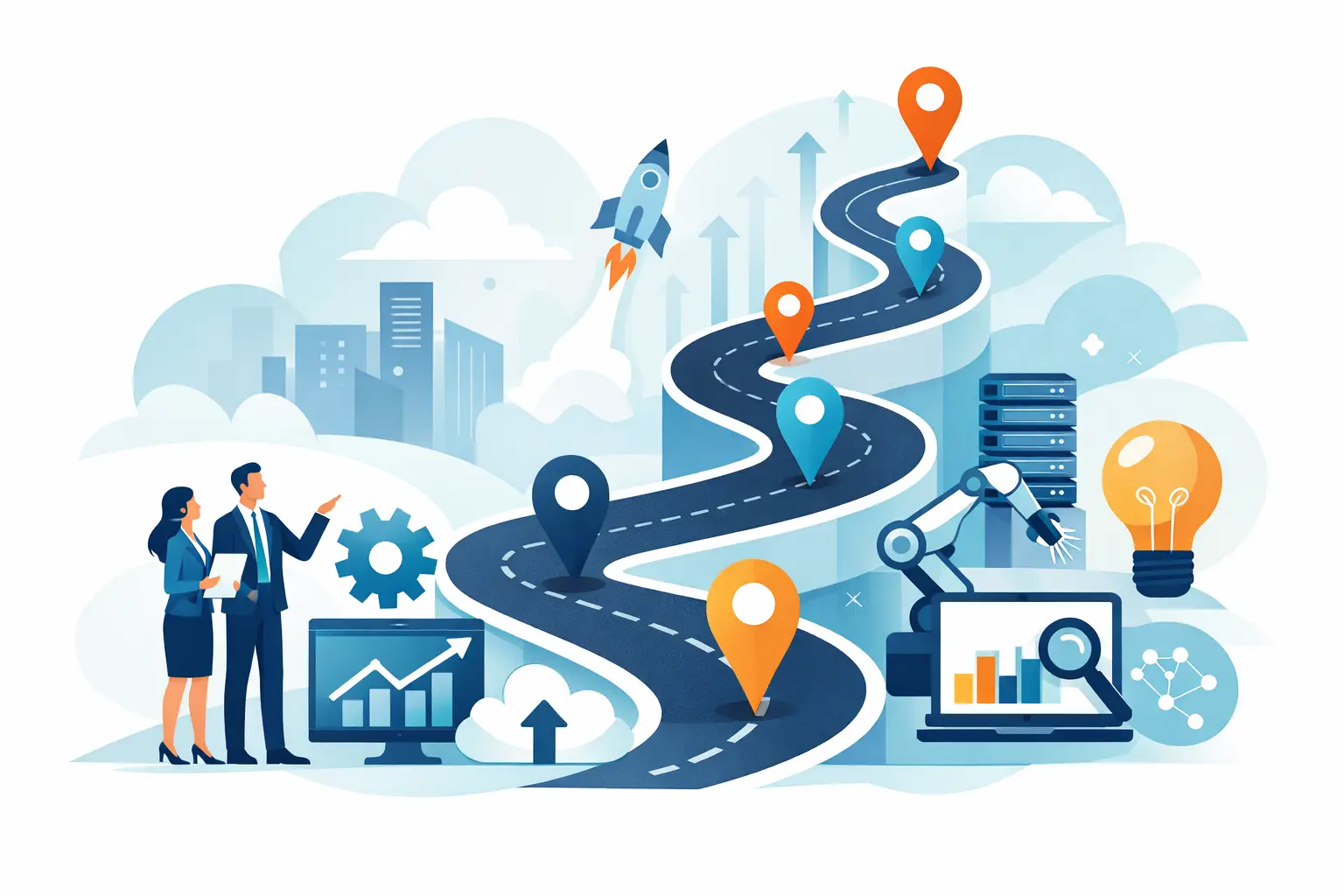
Most enterprise transformation efforts do not fail because leadership lacks ambition. They fail because the work starts with technology decisions before the organization has agreed on operating priorities, ownership, and execution standards. An enterprise digital transformation roadmap guide matters because it forces discipline early, when misalignment is still fixable and before software investments become process debt.
For enterprise leaders, the roadmap is not a presentation artifact. It is a decision framework that connects business goals to process design, platform choices, governance, and adoption. If that connection is weak, transformation becomes a collection of disconnected projects. If it is strong, modernization improves speed, accountability, visibility, and operating performance across functions.
What an enterprise digital transformation roadmap guide should actually do
A useful roadmap does more than sequence initiatives over 12 to 24 months. It clarifies what the business is trying to improve, where current operations are creating friction, and which changes should happen first based on value, risk, and organizational readiness.
That sounds straightforward, but many enterprises overestimate their readiness. They may have too many tools, overlapping processes, fragmented reporting, and inconsistent ownership across teams. In that environment, the roadmap cannot be built around technology alone. It has to account for how work moves through the organization, where decisions stall, and which teams will carry the burden of change.
A strong roadmap typically answers five questions. What strategic outcomes matter most? Which workflows support those outcomes? Where are the current process and systems gaps? What governance model will sustain change? And how will adoption be measured in operational terms, not just rollout milestones?
Start with business outcomes, not platform activity
The first phase of any roadmap should define the business case in operational language. Enterprises often describe transformation goals too broadly - improve customer experience, modernize operations, increase productivity. Those are directionally right, but they are not specific enough to guide implementation.
The better approach is to identify measurable outcomes tied to enterprise performance. That might mean reducing sales cycle delays caused by CRM data quality issues, improving cross-functional visibility for project delivery, shortening approval times in finance or procurement, or increasing capacity by removing duplicate manual work.
This stage is where executive sponsorship becomes real. Leaders need to agree on what success looks like and which trade-offs they are willing to make. For example, standardization may improve scale and reporting, but it can reduce flexibility for business units with specialized workflows. A roadmap that ignores those tensions will look clean on paper and create resistance in practice.
Build the roadmap around workflow reality
Transformation breaks down when leaders map future-state systems without understanding current-state work. The core question is simple: how does work actually get done today?
That means examining handoffs, exceptions, approval chains, data entry points, reporting dependencies, and the informal workarounds teams have built to keep operations moving. In most enterprises, those workarounds tell you more than the official process documentation.
A roadmap grounded in workflow reality usually reveals three categories of issues. First, process inefficiencies, where work moves slowly or inconsistently. Second, systems misalignment, where tools are underused, duplicative, or poorly integrated. Third, governance gaps, where nobody owns the standards that keep the process clean over time.
These findings help leaders avoid a common mistake: digitizing broken workflows. If a process has unnecessary approvals, inconsistent data definitions, or unclear ownership, adding software may accelerate activity without improving performance.
The right sequence for transformation initiatives
An effective enterprise digital transformation roadmap guide should sequence work based on dependency and business impact. Not every initiative belongs in phase one.
In most cases, the first wave should focus on foundational issues that affect multiple functions. That often includes process audits, role clarity, reporting standards, data governance, and platform rationalization. If teams are operating with conflicting workflows and poor system hygiene, advanced automation and analytics will underperform.
The second wave can move into implementation priorities with clearer returns, such as CRM optimization, workflow orchestration, work management standardization, and integration between customer, revenue, and delivery systems. By this point, the organization should have enough structure to absorb change without creating more operational complexity.
The third wave is where many enterprises want to start - automation at scale, advanced dashboards, AI-assisted processes, and more mature decision support. Those investments can be valuable, but they depend on disciplined inputs. If the underlying process model is unstable, later-stage capabilities become expensive overlays rather than force multipliers.
Governance is what keeps transformation from drifting
A roadmap without governance is just a timeline. Enterprises need a clear structure for decision-making, prioritization, and accountability.
At the executive level, governance should define who owns strategic direction, funding decisions, and escalation. At the operational level, it should define who maintains workflows, who governs platform standards, and who is responsible for adoption metrics. That distinction matters because strategic sponsorship alone does not keep a CRM clean, maintain project intake quality, or enforce reporting consistency across departments.
Governance also has to match the organization’s complexity. A highly centralized model can improve standardization, but it may slow responsiveness. A federated model gives business units more control, but it requires stronger shared standards. There is no universal answer. The right model depends on company size, operating structure, regulatory needs, and the maturity of internal teams.
Adoption is an operational issue, not a training event
One of the biggest weaknesses in transformation planning is the assumption that implementation ends at go-live. In enterprise settings, adoption is where value is either realized or lost.
Teams do not resist change for abstract reasons. They resist when the new process creates more friction, when reporting expectations are unclear, or when leadership sends mixed signals about what matters. If managers continue accepting offline workarounds, incomplete data, or inconsistent tool usage, adoption will erode quickly.
That is why the roadmap should include an explicit operating model for change. This means role-based enablement, manager accountability, usage expectations, process documentation, and performance measures tied to day-to-day work. Training still matters, but it is only one part of the equation.
For example, if an enterprise implements a work management platform to improve execution visibility, adoption should be measured by planning accuracy, task ownership, cross-functional coordination, and reporting quality. Logging in is not the same as changing how work is managed.
How to evaluate progress in an enterprise digital transformation roadmap guide
Progress should be measured through business performance, process integrity, and organizational adoption. Focusing on only one of those creates blind spots.
Business performance metrics might include cycle time reduction, increased throughput, improved forecast accuracy, lower rework, or stronger customer retention. Process integrity metrics assess whether workflows are being followed consistently and whether the data created by those workflows is reliable. Adoption metrics help leaders see whether teams are actually using the new model as intended.
This is where many enterprises need discipline. A project can be delivered on time and still fail operationally if users bypass the new process or if leadership never defines what good usage looks like. The roadmap should establish review points that test both execution and outcomes, then adjust priorities as the organization learns.
Common mistakes that weaken the roadmap
The most common mistake is treating transformation as a software program rather than an operating model shift. The second is trying to change everything at once. Broad ambition often leads to fragmented execution, especially when multiple departments launch overlapping initiatives without shared standards.
Another frequent issue is underestimating the effort required for process cleanup. Enterprises often want automation before standardization because automation feels like faster progress. In reality, standardization is what makes automation useful.
There is also a leadership challenge. When transformation is delegated too far down without sustained executive involvement, decisions stall and exceptions multiply. But when executives stay too high-level and avoid operational detail, the roadmap loses practical traction. Strong transformation leadership sits between those extremes.
For organizations that need both strategic structure and implementation discipline, this is where a partner like Efience Digital Experience can add value - particularly when internal teams need clearer process architecture, better system alignment, and a more accountable path from planning to execution.
A better way to think about the roadmap
The roadmap should not be viewed as a fixed document that predicts every step. It should function as a controlled progression from diagnosis to design to implementation to optimization. That keeps the organization focused on what matters now while preserving enough flexibility to respond to new constraints, adoption signals, and business priorities.
Enterprise transformation is rarely slowed by a lack of intent. It is slowed by unclear sequencing, weak governance, and too much distance between strategy and daily work. The organizations that move fastest are usually the ones that first create structure, then use that structure to scale change with less friction and better results.
A useful roadmap does not promise transformation at once. It gives the enterprise a way to make better decisions, in the right order, with accountability built in from the start.