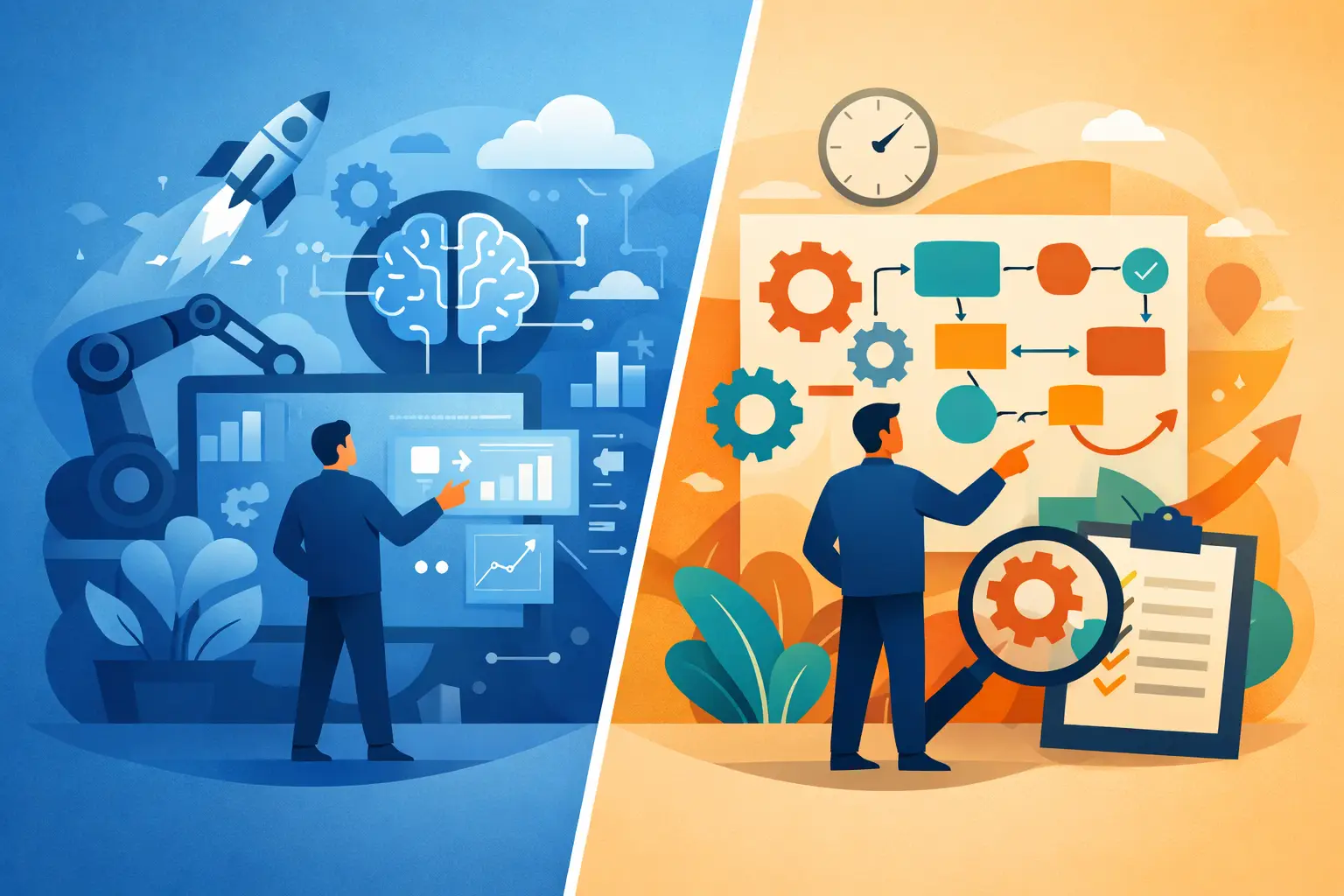
A sales team can spend months refining its CRM stages, reducing duplicate fields, and clarifying handoffs - then still miss forecast targets because customer data sits across disconnected systems. That distinction sits at the center of digital transformation vs process improvement. Both can improve performance, but they address different levels of the operating model.
For enterprise leaders, confusing the two creates a predictable problem: a strategic transformation initiative is reduced to a series of local workflow fixes, or a straightforward process issue becomes an expensive technology program. The right investment depends on what is actually limiting execution, accountability, and scale.
Digital Transformation vs Process Improvement: The Core Difference
Process improvement makes an existing way of working more efficient, consistent, and measurable. It examines how work moves through a team or function, identifies delays and failure points, and redesigns the workflow to produce a better outcome. The scope may be a lead-routing process, project intake, customer onboarding, approval cycle, or monthly reporting process.
Digital transformation changes how the organization creates value and operates through technology, data, and new ways of working. It reaches beyond a single workflow to affect the systems, decision rights, customer experience, data model, skills, and governance that support the enterprise. A transformation may replace fragmented tools with an integrated operating environment, introduce shared performance data, or fundamentally change how teams collaborate across functions.
The difference is not that one involves technology and the other does not. Most meaningful process improvements use technology in some form. The question is whether technology is supporting a better version of the current process or enabling a materially different operating model.
Consider a customer-support organization. Standardizing ticket categories, automating triage rules, and setting service-level ownership is process improvement. Unifying customer history across service, sales, product, and billing systems so every interaction is informed by the same data is digital transformation. The first improves the support workflow. The second changes the enterprise's ability to manage the customer relationship.
Why the Distinction Matters for Enterprise Investment
Transformation budgets, executive attention, and change capacity are finite. Labeling every improvement initiative as digital transformation can create inflated expectations and unnecessary complexity. Leaders may approve broad platform investments without resolving basic process ownership, leading to low adoption and workarounds that undermine the new system.
The reverse is equally costly. Treating a cross-functional transformation challenge as a process-cleanup exercise can preserve structural weaknesses. A team may optimize reporting, for example, while leaving the underlying data fragmented, definitions inconsistent, and accountability for data quality unclear. The reports become faster, but decisions remain unreliable.
A useful test is to ask whether the proposed change can succeed within current system boundaries and organizational roles. If the answer is yes, process improvement may be the appropriate approach. If success requires new data flows, integrated platforms, revised governance, new capabilities, or a different customer and employee experience, the work is likely transformational.
Neither category is inherently more valuable. A well-designed process improvement can remove significant cost, reduce cycle time, and improve employee experience within weeks. A transformation program can create strategic advantage, but it also carries greater dependency, investment, and change-management requirements. The highest-performing organizations know when to apply each discipline.
Process Improvement: Building Reliable Execution
Process improvement starts with operational reality rather than an assumed solution. Teams map the current state, identify where work waits or is reworked, clarify ownership, and measure the factors that affect performance. The aim is not simply to document a process. It is to establish a practical, repeatable way of working that employees can follow and leaders can manage.
This work is especially effective when the issue is contained, the business outcome is clear, and the organization already has capable systems that are underused or poorly configured. A CRM audit may reveal that inconsistent pipeline definitions, weak required-field logic, and unclear account ownership are causing revenue operations problems. Correcting those conditions can improve forecast quality without replacing the CRM.
The same principle applies to work management. An enterprise may have an established platform such as Asana but lack common project templates, intake rules, portfolio visibility, or meaningful reporting. Configuring the platform around the organization's actual operating rhythms can improve coordination quickly. The technology is not the strategy; it is the execution layer for a more disciplined process.
Strong process improvement produces visible controls. Owners understand who makes decisions, teams know what information is required at each handoff, and performance indicators expose exceptions before they become major issues. It also protects the organization from automating waste. Automating an unclear approval process only moves confusion faster.
Digital Transformation: Redesigning the Operating System
Digital transformation begins with a business ambition that the current operating model cannot support. The goal may be faster product delivery, a more connected customer experience, scalable post-merger integration, improved service economics, or reliable enterprise decision-making. Technology matters because it creates new capabilities, but capability design must lead platform selection.
A transformation program typically connects several dimensions at once. Data architecture may need to support a shared view of customers or operations. Core platforms may need to integrate rather than operate as isolated systems. Governance must define who owns standards and outcomes across functions. Employees need clear roles, training, and incentives that support the new model.
For example, moving from disconnected sales, delivery, and finance workflows to a coordinated revenue-to-cash environment is not just a software implementation. It requires agreement on account structures, commercial handoffs, delivery milestones, billing triggers, data ownership, and management reporting. Without those decisions, integration can expose inconsistencies without resolving them.
This is why transformation programs should be designed as business change programs with technology workstreams, not technology deployments with a change-management appendix. Executive sponsorship must be active, especially where transformation crosses functional authority. Teams also need a realistic sequence: establish the target operating model, prioritize high-value capabilities, build the necessary foundations, and deliver measurable releases rather than waiting for a single enterprise-wide launch.
Where the Two Approaches Work Together
Digital transformation and process improvement are complementary. Process discipline provides the clarity required to configure systems well, while transformation creates the shared infrastructure that allows improvements to scale across teams and geographies.
The relationship is often sequential, but not always. Before implementing a new CRM, leaders should improve core processes such as lead qualification, opportunity management, and account ownership. Otherwise, the new platform inherits existing ambiguity. After deployment, process improvement continues as usage data reveals adoption gaps, new bottlenecks, and opportunities to refine automation.
In other cases, a transformation foundation must come first. If business units maintain conflicting customer records and separate service platforms, no amount of local process mapping will create an enterprise customer view. Integration, master data standards, and governance are prerequisites. Once those are in place, each function can improve its workflows using consistent information.
The practical question is not whether to choose transformation or improvement forever. It is what must change first to create momentum without creating avoidable rework.
How Leaders Should Prioritize the Work
Start with the business problem in measurable terms. A statement such as “we need digital transformation” is too broad to guide investment. Define the performance gap instead: forecasting takes ten days, customer onboarding requires seven handoffs, project status is manually assembled, or service teams cannot see contract history. Specific problems reveal whether the constraint is process design, system fragmentation, data quality, organizational accountability, or a combination.
Next, assess the scope of dependency. If one team can improve results by changing its workflow, roles, and existing configuration, establish a focused process improvement initiative. If several functions must share information, decisions, and technology to achieve the desired outcome, build a transformation roadmap around those dependencies.
Leaders should also separate quick wins from foundational work. Quick wins are valuable when they prove progress and free capacity, but they should not become distractions from structural change. Foundational initiatives may take longer, yet they require clear milestones tied to business outcomes, such as reduced order-to-cash time, higher forecast accuracy, or improved project margin visibility.
Finally, treat adoption as a performance requirement. A redesigned workflow or integrated platform only creates value when people use it consistently. That requires practical configuration, role-based guidance, accountable leaders, and metrics that show whether the new way of working is improving results. Efience approaches this intersection of strategy, workflow design, and platform enablement as a single operational challenge rather than separate consulting and implementation activities.
The most useful next step is not selecting a label for the initiative. It is identifying the constraint that keeps the organization from performing at the level its strategy requires - then designing a change effort proportionate to that constraint.