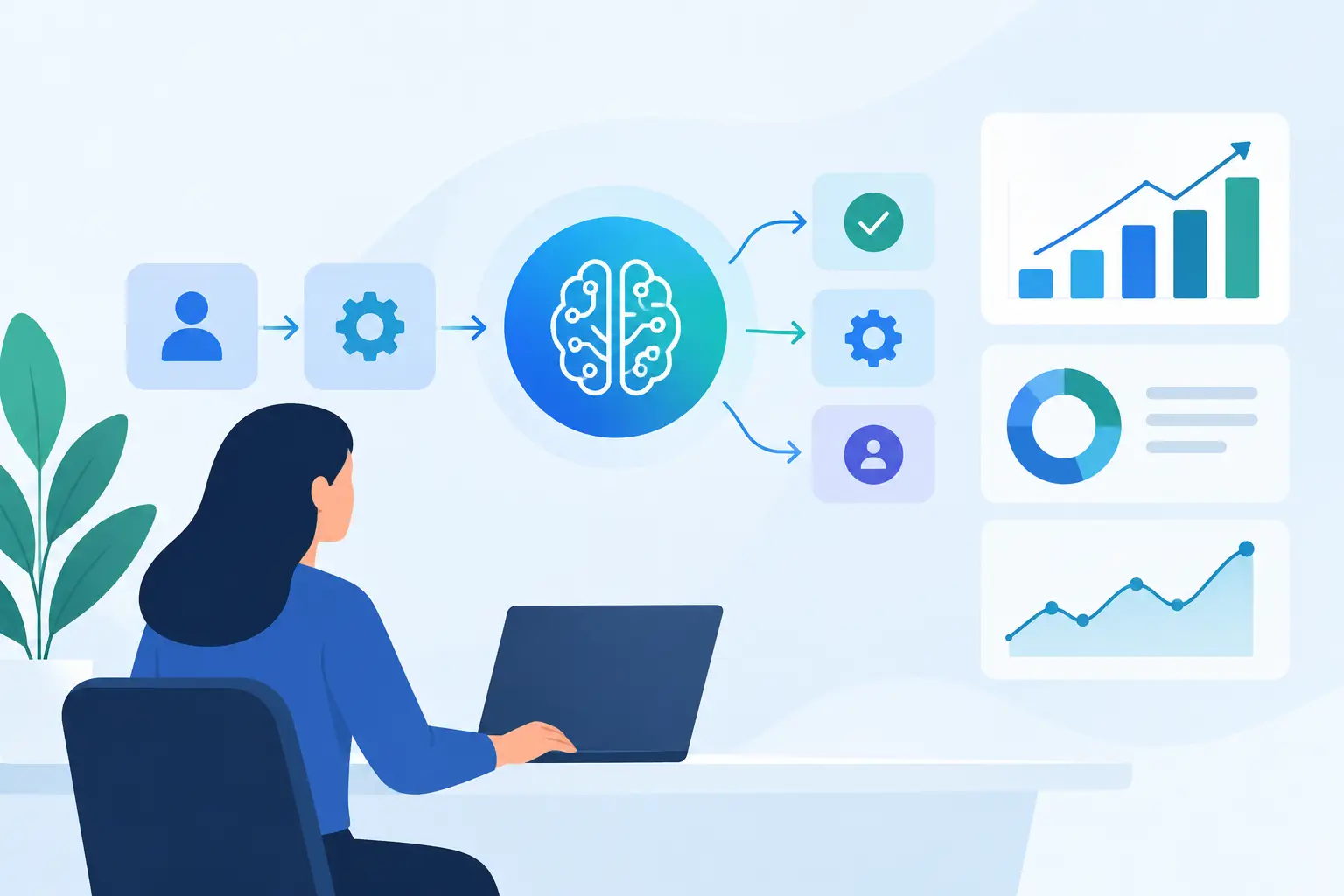
Most operational problems do not begin with a lack of effort. They begin with a lack of visibility. A customer request sits in a shared inbox, an approval waits in an unfamiliar queue, or a team recreates work because the latest status lives in three different systems. AI process intelligence gives enterprise leaders a fact-based way to see these patterns, understand their operational cost, and make targeted improvements.
For organizations investing in digital transformation, this matters because process performance is rarely confined to one platform or department. Revenue operations, customer service, finance, delivery, and internal project teams each create data trails across CRM, workflow, collaboration, and ERP systems. The challenge is turning those trails into a reliable picture of how work actually happens.
What AI Process Intelligence Means in Practice
AI process intelligence combines process data with artificial intelligence to analyze the flow of work across business systems. It goes beyond a documented workflow or a manager's understanding of how a process should operate. The objective is to identify how work is operating in reality, including the exceptions, handoffs, rework, delays, and variations that are often invisible in static process maps.
Traditional reporting can show that a service team closed 1,000 tickets or that a sales organization achieved a certain conversion rate. Process intelligence adds context: which cases took longer, where they stalled, what sequence of actions led to better outcomes, and how behavior differs across regions, teams, customer segments, or product lines.
The AI component makes that analysis more useful at enterprise scale. Rather than asking analysts to manually inspect thousands of process paths, AI can detect recurring patterns, flag unusual cases, group similar journeys, and help teams prioritize the process changes most likely to improve performance. It can also make operational data more accessible through natural-language questions, although executive decisions should still be validated against source data and business context.
Why Process Visibility Has Become a Performance Issue
Enterprise systems have improved the ability to record work, but they have also increased fragmentation. A single customer onboarding process might begin in a CRM, move through contract management, trigger tasks in a work management platform, require financial validation, and end with an implementation handoff. Each system may function well independently while the end-to-end process remains slow and difficult to govern.
This is where process intelligence changes the conversation. Instead of debating whether a team is following a designed workflow, leaders can examine the actual path from request to outcome. They can see whether approvals are creating avoidable queues, whether cases are being routed to the wrong team, or whether a workaround has become an unofficial operating standard.
The benefits are not limited to cost reduction. Better process visibility supports faster customer response, more predictable delivery, stronger compliance, cleaner data, and more realistic capacity planning. It also provides a more credible foundation for automation. Automating a flawed workflow simply allows the organization to repeat its inefficiencies more quickly.
The Difference Between Process Mining and AI Process Intelligence
Process mining is a core capability within the broader process intelligence discipline. It uses event logs from enterprise systems to reconstruct process flows. For example, process mining can show the sequence of activities in an order-to-cash process, measure cycle times, and reveal variants from the intended path.
AI process intelligence builds on this foundation. It applies machine learning, predictive analysis, and increasingly generative AI capabilities to interpret a larger and more complex set of signals. It can help identify the factors associated with delayed outcomes, predict cases at risk of breaching a service-level agreement, and recommend areas for investigation.
The distinction matters because executives should not treat AI as a substitute for sound operational analysis. AI can surface high-value patterns, but it cannot determine whether a process variation reflects a legitimate customer need, a regulatory requirement, or a breakdown in accountability. That requires business owners who understand the operating model and the intended customer or employee experience.
Where AI Process Intelligence Creates Value
The strongest use cases have three characteristics: the process is business-critical, the data exists across relevant systems, and the organization has authority to act on findings. High-volume processes with measurable service, cost, or risk implications are often the best starting point.
In customer onboarding, leaders can identify the handoffs and document requests that extend time to value. In revenue operations, they can examine lead routing, opportunity progression, discount approvals, and forecast hygiene to reduce friction between marketing, sales, finance, and customer success. In service operations, they can analyze repeat contacts, escalation patterns, resolution delays, and routing accuracy.
Internal operations also benefit. Procurement, employee onboarding, project intake, and financial close processes frequently involve unnecessary follow-up work and unclear ownership. When those issues are visible, organizations can redesign workflows, clarify decision rights, and configure technology around the work that teams need to complete.
It depends, however, on the quality of the underlying process data. If event timestamps are inconsistent, case identifiers do not connect across systems, or teams routinely perform key work outside governed platforms, the analysis may create false confidence. Data preparation and process governance are not optional implementation details. They determine whether the insights can be trusted.
Moving From Insight to Operational Change
A process intelligence initiative should not begin with a broad request to analyze everything. Enterprise leaders need a defined business question and an accountable process owner. A practical starting point might be reducing customer onboarding time, improving CRM stage discipline, or lowering the number of projects that miss internal approval deadlines.
First, define the outcome that matters and establish a baseline. Cycle time, rework rate, first-contact resolution, conversion, compliance exceptions, and backlog age are examples, but the right measure depends on the process. A metric without an agreed business outcome can lead teams to optimize activity rather than performance.
Next, map the systems, data owners, and handoffs involved. This step often reveals a central transformation issue: no one owns the end-to-end process, even though several departments own parts of it. The initiative needs executive sponsorship and cross-functional participation to avoid producing insights that individual teams cannot implement.
Then, use the analysis to separate structural issues from isolated exceptions. A one-off delay may require case management. A recurring delay at the same handoff may call for redesigned roles, changed approval thresholds, workflow automation, or better system integration. The response should fit the cause.
Finally, build improvement into the operating rhythm. This means assigning owners, documenting the revised process, configuring platforms to reinforce the new workflow, and monitoring the metrics after launch. A process intelligence dashboard that is reviewed once is not transformation. It is a diagnostic artifact.
The Governance Questions Leaders Need to Address
AI process intelligence introduces governance considerations that deserve executive attention. Process data can expose employee behavior, customer information, and sensitive operational decisions. Organizations need clear policies for data access, retention, aggregation, and acceptable use.
Leaders should also be precise about the role of AI-generated recommendations. A system may identify that a specific team has longer case resolution times, but that observation does not explain the cause. The team may be handling more complex cases, supporting a different customer segment, or working with incomplete upstream data. Human review protects against simplistic conclusions and helps maintain trust.
Model transparency matters as well. If a platform predicts late delivery or recommends a process change, process owners should understand the inputs, confidence level, and limitations of that recommendation. The goal is not to remove judgment from operations. It is to give judgment better evidence.
Connecting Intelligence to the Digital Workplace
Process improvement succeeds when the operational design and the digital workplace reinforce one another. A revised approval path is unlikely to hold if teams continue to manage requests through email. A new project intake standard will not improve accountability if the work management platform lacks clear ownership, status definitions, and reporting conventions.
This is why process intelligence should connect directly to systems assessment and implementation. CRM configuration, workflow design, integration architecture, and work management practices are all part of the same performance system. Efience approaches these areas as connected operational decisions, helping organizations translate strategic process goals into practical ways of working.
The most valuable result is not a more sophisticated process map. It is a business environment where leaders can identify friction early, teams understand how work moves, and technology supports disciplined execution. Start with a process that has a measurable consequence, give one accountable owner the authority to improve it, and let the evidence guide the next decision.